 I began to do the storyboard for the story's rough draft and I realized that it's impossible to produce without other people involved in the production! I can't act, direct, edit, and build it all! So I got scouting for friends and family to help me make this a quality production, I'll still be fully responsible for editing and directing, but I won't be on screen nor will I be responsible for transportation to and from sets & shooting locations! Since I'll b behind the camera I'll be running a casting session for my friends and family to land a role in the opening. For transportation, my dad will be taking the props, the actors, and me back and forth between locations. More to come on the team and the casting process! I have A LOT to do to get ready for shooting according to my calendar, so it's time for me to get some coffee and go full steam ahead!
Sunday, March 3, 2019
Assembling the team!
I began to do the storyboard for the story's rough draft and I realized that it's impossible to produce without other people involved in the production! I can't act, direct, edit, and build it all! So I got scouting for friends and family to help me make this a quality production, I'll still be fully responsible for editing and directing, but I won't be on screen nor will I be responsible for transportation to and from sets & shooting locations! Since I'll b behind the camera I'll be running a casting session for my friends and family to land a role in the opening. For transportation, my dad will be taking the props, the actors, and me back and forth between locations. More to come on the team and the casting process! I have A LOT to do to get ready for shooting according to my calendar, so it's time for me to get some coffee and go full steam ahead!

Saturday, March 2, 2019
Procrasination at it's finest!
Although I don't like to admit it, sometimes I procrastinate. I am involved in so many things outside of school that I wanted to find a way to not fall behind on my media project, at first I thought it would be easy to incorporate this project into my schedule, but this turned out to be a real problem! As I'm writing this, I'm currently in a hotel room in Orlando Florida, more than 200 miles from my home, attending a state business competition; it's 2:15 am and it has been about one hour since I realized that I needed to establish new rules! I have changed my schedule to account for shooting the opening. In order to maintain a consistent pace through the project, I created a shooting calendar and deadlines for myself.
 I made a production calendar in Microsoft Word by using a simple template from Microsoft's template collection. I had to take into account my school workload, extracurricular activities, volunteering hours, and preparation for SAT/ACT testing. I organized the production process into general umbrellas to help me navigate my week, I plan on specifying hours and tasks at a later time. To make the new calendar more accessible to me at all times, I copied every event into my phone and asked my Google Assistant to remind me about what I'm doing for this project every day when I wake up. Therefore, even if I do procrastinate, I'll get it the task done on my own deadline! I hope that utilizing technology will also allow me to work around any scheduling issue that may come up while the film opening is in production.
PS: I only included a picture for the month of March because the great majority of my time available in April I'll spend tweaking and analyzing my portfolio project!
Wednesday, February 27, 2019
I Finally Have A Rough Draft For My Story!
After a lot of searching I think I finally have a story rough draft!
It's about lt a young kid who's running away from home with his parental figure... When he reaches the border, a coyote shoots his dad and kills him leaving the young kid to cross the border on his own. When he crosses he meets his uncle for the first time, he's uncle can't financially support him so he sends him off to live in California with his mom's childhood friend who takes him in sends him to study and gets him a job in the field (he's like 12). While he's working in the field he learns from Guadalupe's (the friend) cousin and the filed's owner takes pity on him, teaching him the grape/wine business. He grows up and continues to learn and care for the old man all while he faces violence in his school and is trying to discover who he is with his friends Luca and Andres. Guadalupe ends up dying of heart complications the day of his graduation ceremony, but she gets to tell him that she loved him like a son and that his mother would be very proud of who he has become...What he doesn't know is that the song his mother used to sing him when he was little is actually a VERY butchered rendition of a star-spangled banner, he sang that as Guadalupe was passing away... In the end, he comes to the realization that his mother had always intended for him to go to America in the search for the American dream... His mother used to say "look up at the stars, you can see them, yes, but you can hear them too... Listen..." That's where the title "The song of the stars" comes from also symbolic because of the iconic song "STAR spangled banner" which is the U.S's national anthem; truly, this film is a coming of age story about a young immigrant chasing the American dream while he struggles to find self-worth because of his rough past. Eventhough it's still a rough draft, I really like this story, it allows me to symbolically represent important social & personal topics while using a narrative that paints imigrant's reality.
Tuesday, February 26, 2019
The Creative Process Behind Building My Project's Plot
NOTES: I decided to create two separate postings to present the creative process and the actual plot.
For the past week, I've been struggling to come up with a plot for my opening; I tried many techniques to stimulate my creative process, I didn't feel any of my ideas were original enough to put into production, through this process I was able to make three rough drafts for a story!
The Creative Process
To help me come up with ideas for an original fiction story I first decided to write themes I would like to address in future productions, I incorporated what I learned from my research into storytelling and story building to create a physical chart on the wall of my room. Any free time I could get my hands on was used trying to figure out what story I wanted to tell, I created timelines, plot lines, brainstorming diagram, and mindmaps to try to organize my thoughts. The methods I used are listed and explained below:
 1)Brainstorming:
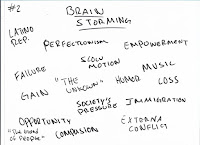
I personally brainstorm in a VERY messy way because as thoughts flow out of me they are messy and unorganized; however, after I compile papers full of random words and phrases I try to reassemble them back into context by using a brainstorming diagram. The benefit of brainstorming is that there is no right way to do it! It's a very individual activity which is VERY flexible and can accommodate anyone, whether you wake up halfway throught the night to write something down or you sit for a timed brainstorming session, it helps either way! For the project, I decided to put on a different type of music on, at different times, on different days (allowing me to change moods/perspectives) and just writing the first thing that came to my mind. By the end of my 3rd day, I could identify constant themes that kept appearing on my notes.

2)Mindmaps:
Mindmaps are basically the same thing as brainstorming diagrams, personally, the only difference is that mindmaps directly try to link preconceived ideas to each other. After completing my plot & creating my characters, I created a mindmap (which can be found in the next posting) to better understand the relationship between my story's characters in a literal and symbolic way; therefore allowing me to better develop the film's opening.
3)Plotlines & Timelines:
Plot lines outline the basic plot of the story including the intro, rising action, climax, falling action, and the resolution. I created a basic plotline to help me see the "big picture" in the development of my story. Timelines are similar with the difference that it is much more specific in the events that occur in the story, it is important for me as a storyteller to be able to identify turning points in the plot and be able to enhance the story by acknowledging their future existence at the beginning (foreshadowing). The timeline can be found in the next post.
4)Physical Door Chart:
 I'm a visual learning so I knew that if I wanted to truly be able to organize my ideas fast and fluently I would need a visual representation of them;ergo, I wrote the main themes I identified from my brainstorming session on post-it notes and I pasted them all on my door, keeping open space for what I planned to include. Every time I walked out of my room I would be reminded that I had to choose the themes soon, this afternoon I finally sat down and chose the story's themes, this helped me narrow my ideas when planning the story's narrative.
For the past week, I've been struggling to come up with a plot for my opening; I tried many techniques to stimulate my creative process, I didn't feel any of my ideas were original enough to put into production, through this process I was able to make three rough drafts for a story!
The Creative Process
To help me come up with ideas for an original fiction story I first decided to write themes I would like to address in future productions, I incorporated what I learned from my research into storytelling and story building to create a physical chart on the wall of my room. Any free time I could get my hands on was used trying to figure out what story I wanted to tell, I created timelines, plot lines, brainstorming diagram, and mindmaps to try to organize my thoughts. The methods I used are listed and explained below:
 1)Brainstorming:
 I personally brainstorm in a VERY messy way because as thoughts flow out of me they are messy and unorganized; however, after I compile papers full of random words and phrases I try to reassemble them back into context by using a brainstorming diagram. The benefit of brainstorming is that there is no right way to do it! It's a very individual activity which is VERY flexible and can accommodate anyone, whether you wake up halfway throught the night to write something down or you sit for a timed brainstorming session, it helps either way! For the project, I decided to put on a different type of music on, at different times, on different days (allowing me to change moods/perspectives) and just writing the first thing that came to my mind. By the end of my 3rd day, I could identify constant themes that kept appearing on my notes.


2)Mindmaps:
Mindmaps are basically the same thing as brainstorming diagrams, personally, the only difference is that mindmaps directly try to link preconceived ideas to each other. After completing my plot & creating my characters, I created a mindmap (which can be found in the next posting) to better understand the relationship between my story's characters in a literal and symbolic way; therefore allowing me to better develop the film's opening.
3)Plotlines & Timelines:
Plot lines outline the basic plot of the story including the intro, rising action, climax, falling action, and the resolution. I created a basic plotline to help me see the "big picture" in the development of my story. Timelines are similar with the difference that it is much more specific in the events that occur in the story, it is important for me as a storyteller to be able to identify turning points in the plot and be able to enhance the story by acknowledging their future existence at the beginning (foreshadowing). The timeline can be found in the next post.
4)Physical Door Chart:

Sunday, February 24, 2019
The Art of Storytelling!
This is a big one.
My hero, Walt Disney, was a master storyteller; he spent his entire life researching and creating new ways to deliver meaningful stories to his audience. Walt’s love for innovation fueled his ability to continue pushing the boundaries of storytelling until his last moments, I strive to do the same. This made my next research topic very personal.
I’ve been extensively researching the most important aspect of filmmaking, storytelling. In my research, I found it isn’t always the story we tell, but the way we tell it that makes for a great film.
Storytelling is an art, NOT a science

There is no perfect formula of how to tell a great story, there are no rules set in stone, and there is no magic wand. However, years of great storytelling in film have made understood guidelines to help facilitate the process of successfully telling a great story. Andrew Stanton, Oscar-winning filmmaker at Pixar, talked about some of these “clues” to great storytelling on his 2012 Ted Talk. “Make me care” Stanton said, the job of a good film opening is to make a promise to the audience, a promise that the story will have some resolution, whatever it may be. I found this to be eye opening, I returned to some of my favorite movies to look for that promise; I found all of them shared this concept of a “promise” that drove both the narrative towards a resolution and helped keep the audience engaged. Although this was revealing, the most important thing I learned from Stanton’s Ted Talk was the importance of evoking a sense of wonder in viewer; that’s what great cinema does, it evokes a sense wonder in the hope that through that wonder, the audience can learn something from the story.

Storytelling deals with emotion, a deeper and rawer form of human feelings; it’s because of this that storytelling could never be a science. However, storytelling has components of of one science field, psychology. In a 2018 Ted Talk, Will Storr talked about the aspects that storytelling shares with psychology. One of the six similarities he shared was a love for change, our brains are obsessed with change, every second of every day we are constantly exposed to change and our brains are constantly processing that change by trying to make sense of many individual stimuli. Andrew Stanton called this the “The rule of 2+2”, the basis is simple: Don’t spoon feed the audience, as humans we want to work for our meal. If you give the audience 4, the story is boring and they feel cheated; instead, give the audience 2+2 and let them figure it out. I personally love this guideline, I believe the audience will appreciate connecting the dots in a story as it develops.
What is behind great a great story?

One of the most common advice when creating a story is “write what you know”. This is often misunderstood, it’s not about only writing the mundane, it’s about including a piece of the ordinary in the extraordinary. Pete Docter, a film director at Pixar Animation Studios, said “Go ahead and write about monsters and explosions and car chases, but put something into it that talks about your own life.” Why? Because that is what brings life and reliability to your story. Everything we experience makes us feel something, by infusing stories with the essence of those experiences, it creates the opportunity for the audience to feel the same way;therefore, giving the story life. Docter talks about Monsters Inc, how it isn’t just about a monster who works scaring children, but it’s truly the story about a sully becoming a father figure to boo, something that Doctor was undergoing as they worked on the film. Including some personal aspect of real life in a story also makes it relatable, because the audience can better relate to the character's situation.
If a tree falls in the middle of the forest, does it make a sound? Change the context and the is much clearer than this old philosophical question; “If a good story is told for no audience, does it serve its purpose?” No! It doesn’t because one of the most important parts of a story is the audience! In an interview for the Atlantic, former Disney CEO Michael Eisner explained that if a story is told in the middle of the desert for no audience it loses its purpose. Great storytellers understand their audiences and tell their stories so that spectators can learn something from it. It is perfectly logical, a great story needs a great audience because if the viewer isn’t willing to learn anything from the story, they won’t.
 I suppose the greatest aspect of a good story is it’s humanity. For as long as humans has been able to communicate with each other we have been telling stories, our history is nothing more than a recollection of past events, both facts and fiction, that we tell each generation in the hopes of delivering a message about our lives. Great stories are human because we are human, we innately infuse ourselves into the stories we tell, and that’s what in my opinion makes the greatest stories. If we want to truly care for a character, he/she must exhibit a human characteristic; Guillermo del Toro understood this when he filmed the shape of water, he knew that for the audience to care about the fishman, under all the makeup and visual effects, there had to be a certain humanity to him. We relate to, and care for, human stories better, so even if a story doesn’t seem human at first glance, it’s spirit must be human.
Storytelling changes our perspectives
 Recently I read The Things They Carried a novel by Tim O’Brien, although the book mainly revolves around the Vietnam War I learned a VERY important lesson from analyzing it, it’s a book about storytelling and how it has the ability to manipulate our perspectives. I have never better understood the importance of the quote “With great power comes great responsibility” from the deceived legend Stan Lee, storytelling gives the storyteller an incredible amount of power because the delivery of a story can make us laugh or cry and it can certainly shape our way of seeing/approaching a situation. This is why it's so important for storytellers to make responsible decisions about the stories we decide to tell, because we are all storytellers, and our stories will outlive us and affect all those around us. Through this project I want to tell a story that can change perspectives.
My hero, Walt Disney, was a master storyteller; he spent his entire life researching and creating new ways to deliver meaningful stories to his audience. Walt’s love for innovation fueled his ability to continue pushing the boundaries of storytelling until his last moments, I strive to do the same. This made my next research topic very personal.
I’ve been extensively researching the most important aspect of filmmaking, storytelling. In my research, I found it isn’t always the story we tell, but the way we tell it that makes for a great film.
Storytelling is an art, NOT a science

There is no perfect formula of how to tell a great story, there are no rules set in stone, and there is no magic wand. However, years of great storytelling in film have made understood guidelines to help facilitate the process of successfully telling a great story. Andrew Stanton, Oscar-winning filmmaker at Pixar, talked about some of these “clues” to great storytelling on his 2012 Ted Talk. “Make me care” Stanton said, the job of a good film opening is to make a promise to the audience, a promise that the story will have some resolution, whatever it may be. I found this to be eye opening, I returned to some of my favorite movies to look for that promise; I found all of them shared this concept of a “promise” that drove both the narrative towards a resolution and helped keep the audience engaged. Although this was revealing, the most important thing I learned from Stanton’s Ted Talk was the importance of evoking a sense of wonder in viewer; that’s what great cinema does, it evokes a sense wonder in the hope that through that wonder, the audience can learn something from the story.

Storytelling deals with emotion, a deeper and rawer form of human feelings; it’s because of this that storytelling could never be a science. However, storytelling has components of of one science field, psychology. In a 2018 Ted Talk, Will Storr talked about the aspects that storytelling shares with psychology. One of the six similarities he shared was a love for change, our brains are obsessed with change, every second of every day we are constantly exposed to change and our brains are constantly processing that change by trying to make sense of many individual stimuli. Andrew Stanton called this the “The rule of 2+2”, the basis is simple: Don’t spoon feed the audience, as humans we want to work for our meal. If you give the audience 4, the story is boring and they feel cheated; instead, give the audience 2+2 and let them figure it out. I personally love this guideline, I believe the audience will appreciate connecting the dots in a story as it develops.
What is behind great a great story?

One of the most common advice when creating a story is “write what you know”. This is often misunderstood, it’s not about only writing the mundane, it’s about including a piece of the ordinary in the extraordinary. Pete Docter, a film director at Pixar Animation Studios, said “Go ahead and write about monsters and explosions and car chases, but put something into it that talks about your own life.” Why? Because that is what brings life and reliability to your story. Everything we experience makes us feel something, by infusing stories with the essence of those experiences, it creates the opportunity for the audience to feel the same way;therefore, giving the story life. Docter talks about Monsters Inc, how it isn’t just about a monster who works scaring children, but it’s truly the story about a sully becoming a father figure to boo, something that Doctor was undergoing as they worked on the film. Including some personal aspect of real life in a story also makes it relatable, because the audience can better relate to the character's situation.
If a tree falls in the middle of the forest, does it make a sound? Change the context and the is much clearer than this old philosophical question; “If a good story is told for no audience, does it serve its purpose?” No! It doesn’t because one of the most important parts of a story is the audience! In an interview for the Atlantic, former Disney CEO Michael Eisner explained that if a story is told in the middle of the desert for no audience it loses its purpose. Great storytellers understand their audiences and tell their stories so that spectators can learn something from it. It is perfectly logical, a great story needs a great audience because if the viewer isn’t willing to learn anything from the story, they won’t.
 I suppose the greatest aspect of a good story is it’s humanity. For as long as humans has been able to communicate with each other we have been telling stories, our history is nothing more than a recollection of past events, both facts and fiction, that we tell each generation in the hopes of delivering a message about our lives. Great stories are human because we are human, we innately infuse ourselves into the stories we tell, and that’s what in my opinion makes the greatest stories. If we want to truly care for a character, he/she must exhibit a human characteristic; Guillermo del Toro understood this when he filmed the shape of water, he knew that for the audience to care about the fishman, under all the makeup and visual effects, there had to be a certain humanity to him. We relate to, and care for, human stories better, so even if a story doesn’t seem human at first glance, it’s spirit must be human.
 Storytelling changes our perspectives
Recently I read The Things They Carried a novel by Tim O’Brien, although the book mainly revolves around the Vietnam War I learned a VERY important lesson from analyzing it, it’s a book about storytelling and how it has the ability to manipulate our perspectives. I have never better understood the importance of the quote “With great power comes great responsibility” from the deceived legend Stan Lee, storytelling gives the storyteller an incredible amount of power because the delivery of a story can make us laugh or cry and it can certainly shape our way of seeing/approaching a situation. This is why it's so important for storytellers to make responsible decisions about the stories we decide to tell, because we are all storytellers, and our stories will outlive us and affect all those around us. Through this project I want to tell a story that can change perspectives.
Subscribe to:
Posts (Atom)
The Begining
Hello! My name is Luis! I’m a creative extrovert that enjoys studying advanced management, business, and media. Welcome to my Media Studie...
-
 Why are Disney parks so immersive in comparison to other theme parks? Well, besides their layout which helps the theming process, it was W...
 -
"It's ALIVE!!" Well, not really... but it sounds better than "It's a finalized video file!". I can't believe...
-
 Well, you know what they say, third time's a charm! -At least I hope it is 😐- Today was my third day editing the film opening and I m...